Project Info
Category
Date
False Claims Link Pfizer and WHO Vaccine Documents to Hantavirus Infection
The Claim
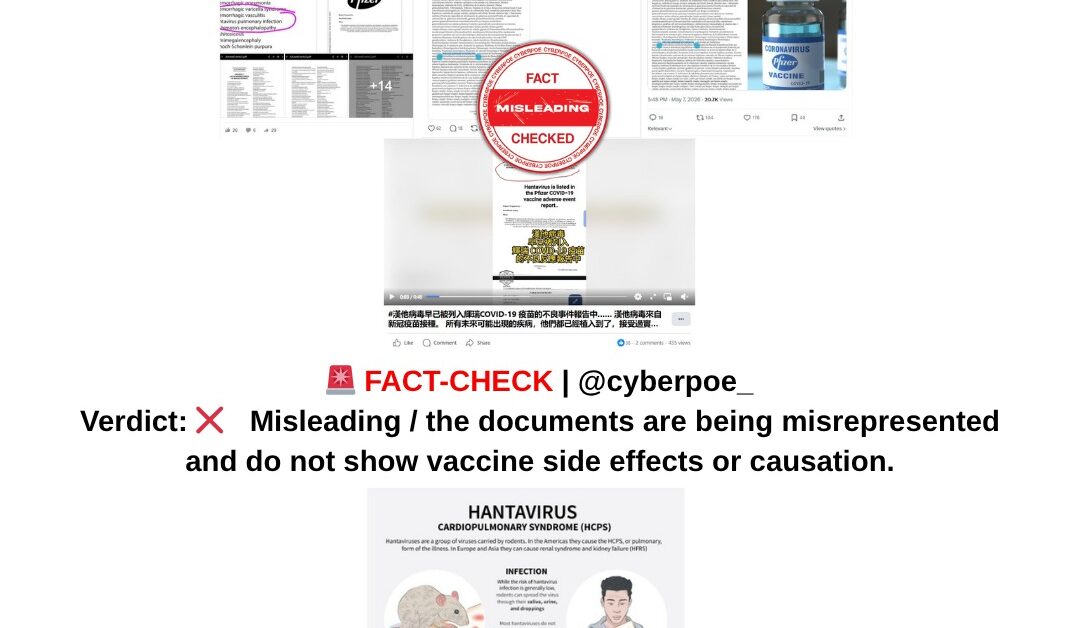
A wave of social media posts across X,[1] Facebook,[2] and in Spanish[3] alleges that Covid-19 vaccines are responsible for a hantavirus outbreak reported aboard the Dutch-flagged cruise ship MV Hondius.
The posts claim that Pfizer’s vaccine documentation lists “hantavirus infection” as a side effect, and that the World Health Organization (WHO) confirms a similar link in its vaccine safety databases. Some versions frame this as evidence that mRNA vaccines can trigger or transmit hantavirus, reviving broader conspiracy theories from the Covid-19 pandemic era.
What CyberPoe Verified
Verification shows the claims are false and based on misinterpretation of medical safety monitoring documents.
The Pfizer document being circulated is a pharmacovigilance reference list, not a list of confirmed vaccine side effects. It includes a broad catalogue of medical events used globally by regulators to monitor and flag any potential safety signals during vaccine rollout.[1]
“Adverse events of special interest,” including conditions like Hantavirus infection, are included for surveillance purposes only and do not indicate causation.
[1] https://phmpt.org/wp-content/uploads/2021/11/5.3.6-postmarketing-experience.pdf
What the Documents Actually Show
The Pfizer dataset shared online originates from materials used in regulatory transparency filings submitted during the Covid-19 vaccine approval process. It was published through a Freedom of Information Act request and later made publicly accessible by a transparency-focused research group.
The document explicitly states that inclusion of a medical condition does not imply it is caused by vaccination. Many listed entries include unrelated medical events such as injuries, environmental incidents, and infections that have no biological connection to vaccines.
Similarly, the WHO’s VigiAccess database records health events reported after medical product use.[1] These entries represent temporal associations, not confirmed adverse reactions.
Health agencies use these systems to detect rare safety signals early, which are then investigated further before any conclusions are drawn.
Medical and Scientific Context
Experts confirmed that Pfizer’s mRNA Covid-19 vaccines do not contain live or inactivated viruses and cannot transmit infections such as Hantavirus.
Medical specialists, including infectious disease experts cited in the investigation, stated there is no biological mechanism linking mRNA vaccination to Hantavirus infection or increased susceptibility to it.[1]
According to the WHO, Hantavirus transmission occurs primarily through contact with infected rodents or contaminated environments, including urine, saliva, or droppings. Human-to-human transmission is rare and limited to specific strains in certain regions.
As of mid-May 2026, the ongoing outbreak aboard the MV Hondius has resulted in a small number of confirmed cases and deaths, all confined to individuals linked to the vessel. Health authorities continue to classify the broader risk to the public as low.
Why the Misinformation Spread
The outbreak triggered renewed circulation of Covid-era vaccine conspiracy theories, with users selectively extracting technical documents to suggest causal links that are not supported by scientific interpretation.
This pattern reflects a recurring misinformation tactic: presenting regulatory safety monitoring data as evidence of harm, while removing the explanatory context that defines how those systems work.
CyberPoe Verdict ❌
Misleading.
Pfizer and WHO documents do not show that Covid-19 vaccines cause Hantavirus infection. The references cited in viral posts are part of standard global pharmacovigilance systems used to monitor and investigate potential health events, not confirmed side effects.
There is no scientific evidence linking Covid-19 vaccination to Hantavirus infection or the current outbreak.
CyberPoe | The Anti-Propaganda Frontline 🌍